
Introduction
Surface preparation is the backbone of any successful coating system. The ISO 8501 series, developed by the International Organization for Standardization, provides globally accepted visual standards for assessing steel surface cleanliness.
This guide covers all key parts: ISO 8501-1, 8501-2, 8501-3, and ISO 8501-4.
ISO 8501 consists of the following parts, under the general title “Preparation of steel substrates before application of paints and related products — Visual assessment of surface cleanliness:”
| Standard | Description |
|---|---|
| ISO 8501-1 | Rust grades and preparation grades of uncoated steel substrates and of steel substrates after overall removal of previous coatings |
| ISO 8501-2 | Preparation grades of previously coated steel substrates after localized removal of previous coatings |
| ISO 8501-3 | Preparation grades of welds, edges and other areas with surface imperfections |
ISO 8501-4 | Initial surface conditions, preparation grades and flash rust grades in connection with high-pressure water jetting |
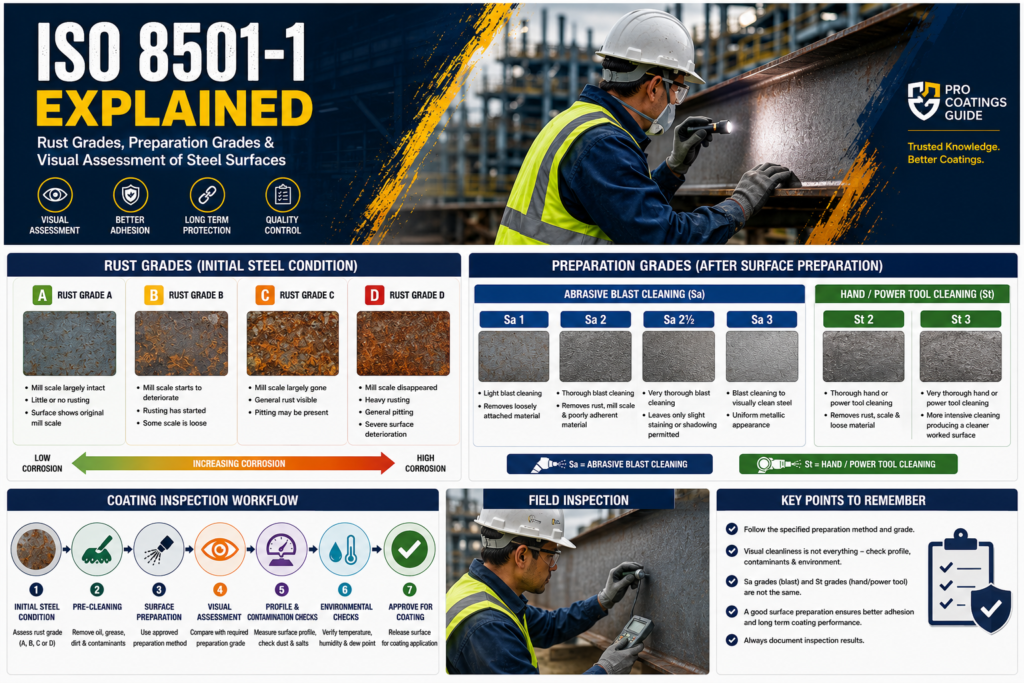
ISO 8501-1: Explained
ISO 8501-1 is widely used in the protective coatings industry as a visual reference for assessing the condition of steel surfaces before and after certain surface preparation operations.
For coating inspectors, QC engineers, painting supervisors and contractors, understanding ISO 8501-1 is an important part of effective surface preparation inspection.
This article explains the basic concepts of ISO 8501-1 in simple, practical language without reproducing copyrighted standard content.
Important: This article is an educational explanation and is not a replacement for purchasing or consulting the official ISO standard. ISO 8501-1 should be obtained from an authorized standards provider for contractual or specification requirements.
What is ISO 8501-1?
ISO 8501-1 is a standard concerned with the visual assessment of surface cleanliness of steel substrates before coating with paints and related products.
In simple terms, it provides a common visual language for describing:
- The initial condition of rusted steel
- The appearance of steel after surface preparation
- The degree of cleaning achieved by different preparation methods
This is particularly useful because people involved in a painting project need to have a common understanding of what a prepared steel surface should look like.
For example, a project specification may require abrasive blast cleaning to Sa 2½.
The inspector, contractor and client can then use the applicable visual reference to evaluate whether the prepared surface appears to meet the required preparation condition.
Why Is ISO 8501-1 Important?
Surface preparation has a major influence on coating performance. Even a high-quality coating system can fail prematurely if it is applied over a poorly prepared surface.
ISO 8501-1 helps the coating industry establish a consistent visual basis for evaluating surface preparation.
It can help with:
1. Initial surface assessment
The existing condition of steel can be categorized according to its visible rust and mill-scale condition.
2. Defining preparation requirements
Specifications can identify a required preparation grade.
3. Inspection
Inspectors can visually compare the prepared surface with the applicable reference condition.
4. Communication
Contractors, inspectors and clients can use standardized terminology instead of relying only on subjective descriptions such as “clean enough.”
5. Documentation
Inspection reports can record the required and achieved preparation grade.
ISO 8501-1 Rust Grades
- Before surface preparation begins, steel can have different degrees of deterioration.
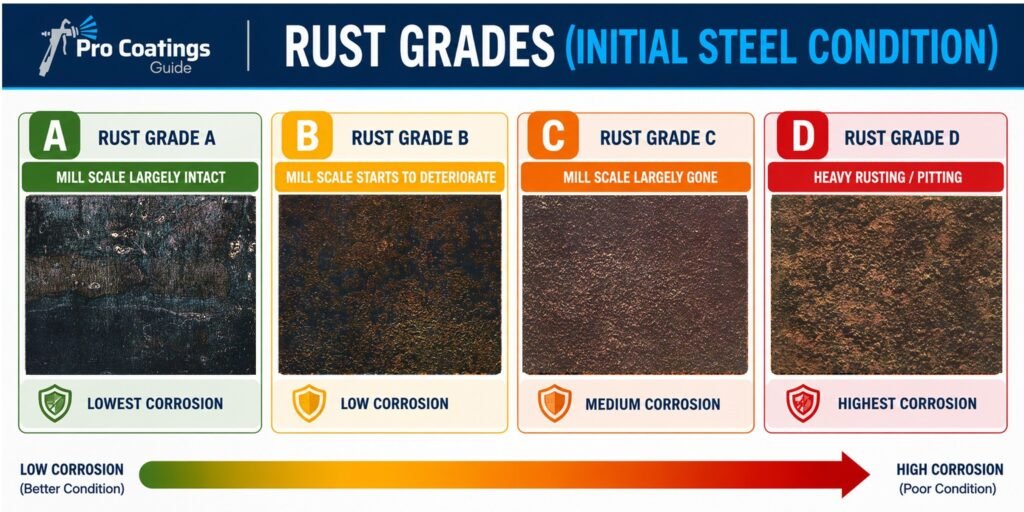
- ISO 8501-1 uses four commonly referenced initial rust grades: A, B, C and D
- These grades describe the general visual condition of uncoated steel before preparation.
Rust Grade A
Grade A represents steel that still has a relatively intact mill-scale layer, with little or no visible rusting. The surface generally retains most of its original mill scale.
Typical appearance
- Mill scale is largely intact
- Little visible rust
- Limited deterioration of the steel surface
Practical significance
A surface in this condition may require preparation to remove mill scale and any contaminants before coating.
Rust Grade B
Grade B represents steel where the mill scale has started to deteriorate because of rust formation.
Some areas of mill scale may have begun to loosen or detach.
Typical condition
- Rusting has started
- Mill scale is beginning to break down
- Some scale may be loose
- Corrosion activity is more apparent than Grade A
Practical significance
Surface preparation will normally need to address both corrosion products and remaining mill scale.
Rust Grade C
Grade C represents steel where the mill scale has largely disappeared because of corrosion.
Some visible pitting may be present.
Typical condition
- Mill scale has rusted away
- General rust is visible
- Surface irregularities or slight pitting may be present
Practical significance
The condition of the steel itself becomes increasingly important because corrosion may have affected the surface profile and caused localized metal loss.
Rust Grade D
Grade D represents a more severely corroded steel surface.
The original mill scale has disappeared and significant general corrosion and pitting may be visible.
Typical condition
- Mill scale has disappeared
- Extensive rusting
- General pitting
- More pronounced surface deterioration
Practical significance
In addition to surface preparation, the structural condition of the steel may need to be evaluated.
Surface preparation cannot restore steel that has already been lost through corrosion.
Understanding Preparation Grades
One of the most important aspects of ISO 8501-1 is the description of preparation grades.
For abrasive blast cleaning, the commonly referenced grades are:
- Sa 1
- Sa 2
- Sa 2½
- Sa 3
For manual and mechanical cleaning, commonly referenced grades include:
- St 2
- St 3
The preparation grade indicates the degree of cleaning achieved by the specified preparation method.
Sa 1 – Light Blast Cleaning
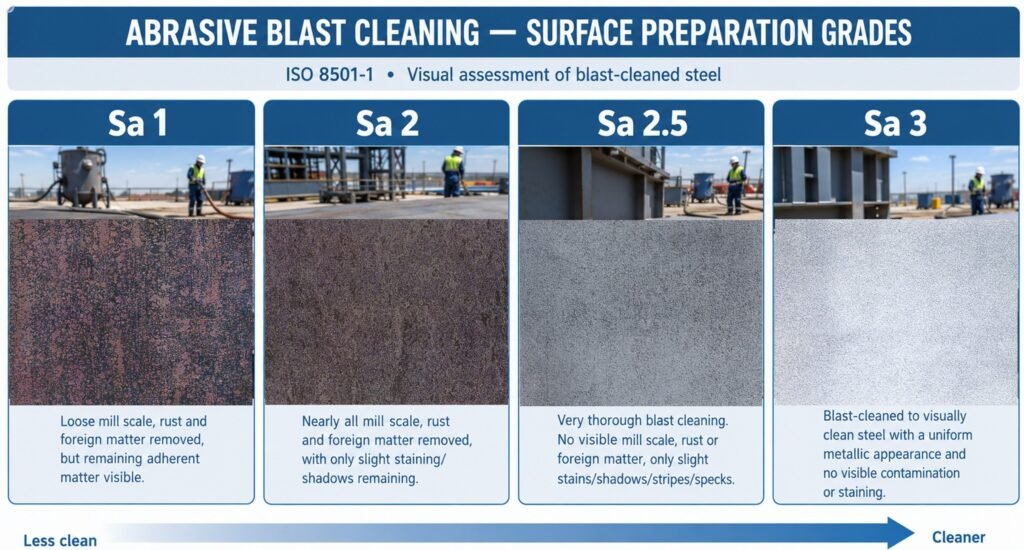
Sa 1 represents a relatively light level of abrasive blast cleaning.
The objective is to remove loosely attached material and other contaminants that can be removed relatively easily by blasting.
In practical terms
The surface is visibly cleaner than the original condition, but tightly adherent material may remain.
Typical application
This level may be suitable only where the coating specification permits a lower degree of preparation.
For critical protective coating systems, higher preparation grades are often specified.
Sa 2 – Thorough Blast Cleaning
Sa 2 represents a more thorough level of abrasive blast cleaning.
A significant amount of rust, mill scale and other poorly adherent material is removed.
The surface should show
- Substantial removal of corrosion products
- Removal of loosely attached mill scale
- Removal of poorly adherent contaminants
- A substantially cleaner steel surface
The remaining appearance depends on the original condition of the steel and the blasting operation.
Sa 2½ – Very Thorough Blast Cleaning
Sa 2½ is one of the most commonly specified blast-cleaning grades in industrial protective coating work. It represents a very thorough degree of abrasive blast cleaning.
The objective is to remove corrosion products, mill scale and other foreign matter to a very high degree, leaving only limited staining or discoloration where permitted by the applicable visual reference.
Why is Sa 2½ so commonly specified?
Because many industrial coating systems require a high level of surface cleanliness to achieve reliable adhesion and long-term corrosion protection.
Sa 2½ is frequently encountered in projects involving:
- Oil and gas facilities
- Refineries
- Petrochemical plants
- Storage tanks
- Structural steel
- Pipelines
- Offshore structures
- Power plants
- Heavy industrial equipment
However, the required preparation grade should always come from the coating specification or approved coating system—not from an assumption that Sa 2½ is automatically required for every job.
Sa 3 – Blast Cleaning to Visually Clean Steel
Sa 3 represents the highest commonly referenced level of abrasive blast cleaning in this series.
The objective is to produce a visually clean steel surface with the contaminants and corrosion products removed to the degree required by the preparation grade.
The resulting steel generally has a highly uniform metallic appearance, although the exact visual appearance can vary according to the original steel condition, abrasive, equipment and preparation process.
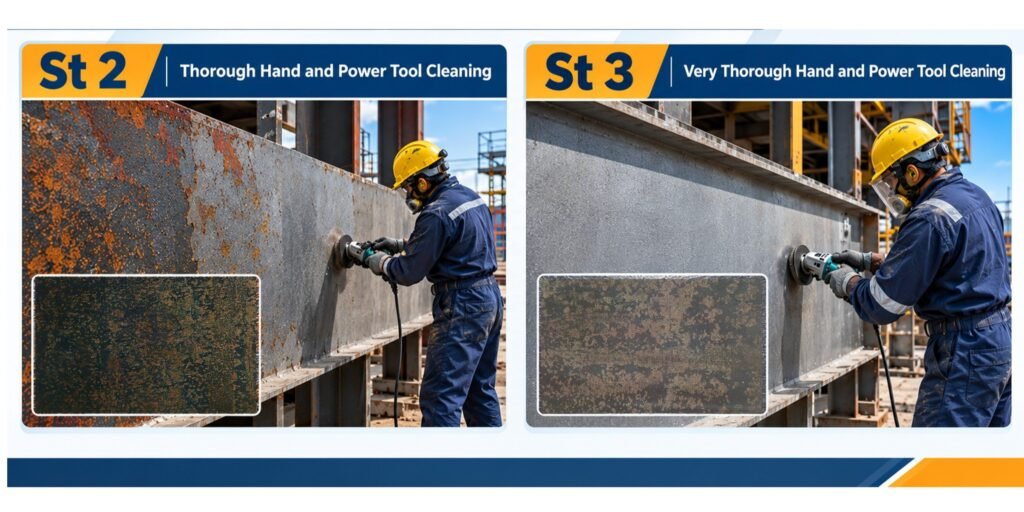
St 2 – Thorough Manual or Power Tool Cleaning
The St designation is associated with cleaning using hand tools or power tools rather than abrasive blast cleaning.
St 2 represents a thorough level of cleaning.
The process is intended to remove poorly adherent:
- Rust
- Mill scale
- Coating residues
- Foreign matter
Tools may include:
- Wire brushes
- Scrapers
- Chipping tools
- Needle scalers
- Grinders
- Mechanical brushes
The prepared surface should be free from loose material that could interfere with coating application.
St 3 – Very Thorough Manual or Power Tool Cleaning
St 3 represents a more thorough level of manual or power tool cleaning than St 2.
The process is more intensive and may involve mechanical tools capable of producing a more thoroughly cleaned and worked steel surface.
Typical tools can include:
- Power grinders
- Rotary wire brushes
- Needle scalers
- Mechanical scalers
- Other suitable power tools
The final appearance depends on the tool and method used.
Sa Grades vs St Grades
A simple way to remember the difference is:
| Designation | Preparation Method |
|---|---|
| Sa | Abrasive blast cleaning |
| St | Hand or power tool cleaning |
Therefore:
Sa 2½ ≠ St 3
They are different preparation methods and should not be treated as interchangeable.
The appropriate preparation method and grade should be specified based on the coating system, substrate condition, service environment and project requirements.
ISO 8501-1 Is Not Only About "Cleanliness"
A common misunderstanding is that ISO 8501-1 simply tells an inspector whether steel is “clean.”
In practice, visual surface preparation assessment involves more than looking for visible dirt.
An inspector should consider:
Rust and corrosion products
Are rust and corrosion products adequately removed?
Mill scale
Has remaining mill scale been removed to the required degree?
Existing coatings
For maintenance work, have poorly adherent coatings and corrosion products been removed as required?
Visual staining
Is remaining staining consistent with the specified preparation grade?
Surface condition
Is there visible pitting or deterioration of the steel?
Preparation consistency
Has the required level of preparation been achieved consistently across the inspected area?
Surface Profile and ISO 8501-1
A visually acceptable surface does not automatically mean that the surface profile is correct.
Abrasive blasting normally creates a roughened surface that helps a coating mechanically anchor to the substrate.
The required profile depends on the coating manufacturer’s requirements and project specification.
Therefore, after achieving the required visual preparation grade, the inspector may need to measure the surface profile using an appropriate method.
A good inspection sequence is therefore:
Surface preparation → Visual cleanliness assessment → Surface profile measurement → Dust/salt contamination checks → Environmental checks → Coating application
The exact inspection sequence should follow the project specification and approved inspection plan.
Common Mistakes When Using ISO 8501-1
Mistake 1: Treating Sa 2½ as "perfectly shiny steel"
Sa 2½ should not simply be interpreted as “shiny metal.”
The assessment is based on the applicable visual reference condition.
Mistake 2: Assuming every project requires Sa 2½
Sa 2½ is common, but it is not automatically the correct requirement for every coating system.
Always follow the approved coating specification.
Mistake 3: Using visual inspection to judge soluble salts
Salt contamination may be invisible.
A dedicated test method may be required.
Mistake 4: Ignoring the original steel condition
The final appearance after blasting can be influenced by the initial rust grade.
A heavily pitted surface will not necessarily look identical to lightly rusted steel after preparation.
Mistake 5: Checking cleanliness but not surface profile
A surface can visually meet the required preparation grade and still have an unsuitable surface profile for the coating system.
Mistake 6: Inspecting only selected areas
Surface preparation should be assessed over the required inspection area rather than relying on one visually representative spot.
ISO 8501-1 Quick Reference
| Grade | General Meaning | Typical Preparation |
|---|---|---|
| A | Mill scale largely intact | Initial steel condition |
| B | Mill scale beginning to deteriorate | Initial steel condition |
| C | Mill scale largely gone, corrosion/pitting visible | Initial steel condition |
| D | Heavily corroded/pitted steel | Initial steel condition |
| Sa 1 | Light blast cleaning | Abrasive blasting |
| Sa 2 | Thorough blast cleaning | Abrasive blasting |
| Sa 2½ | Very thorough blast cleaning | Abrasive blasting |
| Sa 3 | Blast cleaning to visually clean steel | Abrasive blasting |
| St 2 | Thorough hand/power tool cleaning | Hand/power tools |
| St 3 | Very thorough hand/power tool cleaning | Hand/power tools |
Frequently Asked Questions
1. Is ISO 8501-1 only for abrasive blasting?
No.
The standard covers visual assessment of preparation grades associated with different preparation methods. Commonly referenced designations include Sa grades for abrasive blast cleaning and St grades for hand and power tool cleaning.
2. Is Sa 2½ the same as SSPC-SP 10?
They are commonly compared in the industry, but they are not identical standards.
They originate from different standards systems and should not be treated as interchangeable without checking the project specification and applicable requirements.
3. Does ISO 8501-1 measure surface profile?
No.
ISO 8501-1 primarily provides a visual basis for assessing surface condition and preparation. Surface profile requires an appropriate measurement method.
4. Can visual inspection detect soluble salts?
Not reliably.
Soluble salts can be invisible. Where salt contamination is a project concern, an appropriate test method should be used.
5. Can ISO 8501-1 determine coating quality?
Not by itself.
It primarily addresses the visual condition of the steel surface before coating. Overall coating quality requires additional inspection activities.
Disclaimer
This article is intended for general educational purposes. It is an original explanatory article and does not reproduce the copyrighted text, tables, photographs or figures of ISO 8501-1. For contractual, specification, certification or compliance purposes, users should consult the current edition of the official standard obtained from an authorized source.
👇 Click here for other parts of ISO 8501 as follows,
- ISO 8501-2: Preparation grades of previously coated steel substrates after localized removal of previous coatings.
- ISO 8501-3: Preparation grades of welds, edges and other areas with surface imperfections
- ISO 8501-4: Initial surface conditions, preparation grades and flash rust grades in connection with high pressure water jetting

Pingback: ISO 8501-2 Preparation grades of previously coated steel substrates - Pro Coatings Guide