
Surface preparation is the process of cleaning and roughening a substrate before a coating is applied. How a surface is to be prepared for coating application is determined by the requirements outlined in the project specification.
These requirements can vary significantly from one project to another and determine everything from the surface preparation method, the abrasive media, surface profile, and the tests required before and after surface preparation.
Surface preparation usually takes place in three phases. Let’s discuss every topics one by one here !!!
PHASE 1: Initial Surface Condition Assessment
- The first phase of surface preparation is comprised of visually assessing the surface of the substrate to determine the following factors: type of substrate, initial condition, design challenges, and fabrication defects that would affect the surface preparation or coating process prior to surface preparation.
- Any design and fabrication defects such as hard-to-access areas or sharp corners and edges that were identified should be addressed and remedied. The job specification will state the course of action, such as hand and/or power tool cleaning to remedy any design challenge or surface defect identified.
▶️Click below links to check out details on Initial Surface Condition Assessment
PHASE 2: Pre-Cleaning the Surface
- The focus of this step is the pre-cleaning, or removal of visible and non-visible surface contaminants, which may interfere with the bond of the coating to the substrate.
- Visible surface contaminants include oil, grease, dust, and dirt. Non-visible surface contaminants include soluble salts, such as chlorides, sulfates, and nitrates.
▶️Click below links to check out details on Pre-Cleaning the Surface
PHASE 3: Surface Preparation
- Uses the appropriate method, such as hand or power tool cleaning, abrasive blasting, water jetting, etc. to remove detrimental surface contaminants from the surface and to create a cleaned and roughened surface to ensure adhesion of the coating to the substrate or to the existing coatings.
▶️Click below links to check out details on Surface Preparation
Purpose of Surface Preparation:
Surface preparation is the process of cleaning and roughening a substrate before a coating is applied. Modern coatings require both a clean and roughened surface if they are to have long-term stability. However, there are many factors to take into consideration that take place during the surface preparation process that can affect the life of a coating, including:
- Residues of oil, grease, and soil can prevent adhesion or mechanical bonding of the coating to the substrate
- Residues of (non-visible) chemical salts can induce corrosion after coating
- Rust on the surface interferes with adhesion
- Mill Scale:
– Loose or broken mill scale: can cause early coating failure
– Tight mill scale: can cause later coating failure - Rust scale cannot be protected by any coating and cannot maintain adhesion to steel
- Anchor pattern issues (formed by surface preparation actions):
– Maybe so rough that peaks are formed, which are difficult to adequately protect with a coating
– May not be rough enough, possibly causing coating failure because of a loss of adhesion - Sharp ridges, burrs, edges, or cuts from mechanical cleaning equipment can prevent adequate DFT
- Surface condensation if coated over may result in blistering and delamination failure
- Old coatings may have poor adhesion or may be too deteriorated to re-coat
- Existing coatings may be incompatible with and affected by the application of a maintenance coating
Inspecting surface cleanliness for the above listed factors is a continuous process and should take place at least three times during the project:
- Before any surface preparation begins (the focus of this chapter)
- After surface preparation and before coating application begins
- Between each application of coating in a multi-coat system
Surface Profile (Anchor Profile):
- Surface profile is defined as the maximum peak to valley depth that is generated by the abrasive impacting the surface at a high speed during blasting operations and by the impact created using certain power tools.
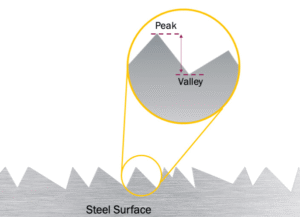
- During blasting, abrasive media cuts (angular abrasives) or peens (round abrasives) the surface creating a series of peaks and valleys. Surface profile measures the maximum peak to valley depth created which provides an anchor for the coating system to adhere to the substrate.
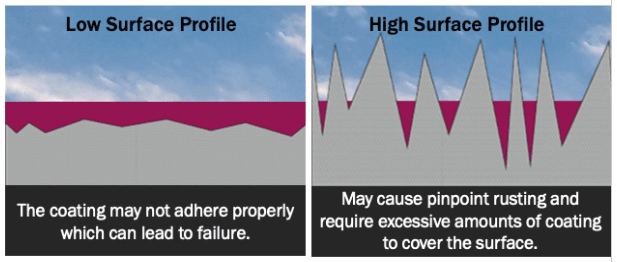
- By imparting a profile, the surface area is increased enhancing the adhesion of the coating system to the surface.
- While an insufficient surface profile depth may result in poor coating system adhesion, excessive profile may cause pinpoint rusting and will require significantly more coating to fill all the valleys of the surface profile and provide the specified thickness of coating above the peaks of the surface profile.
- Therefore, compliance with the minimum and maximum specified surface profile depth is critical to the success of a coating system.
The range of acceptable surface profile depths to achieve, by surface preparation, can be specified by the job specification, the coating manufacturer’s product data sheet, and/or the standard associated with the surface preparation method. After surface preparation is complete, the surface profile is measured, to ensure it meets the specification requirements or governing standard.