Introduction
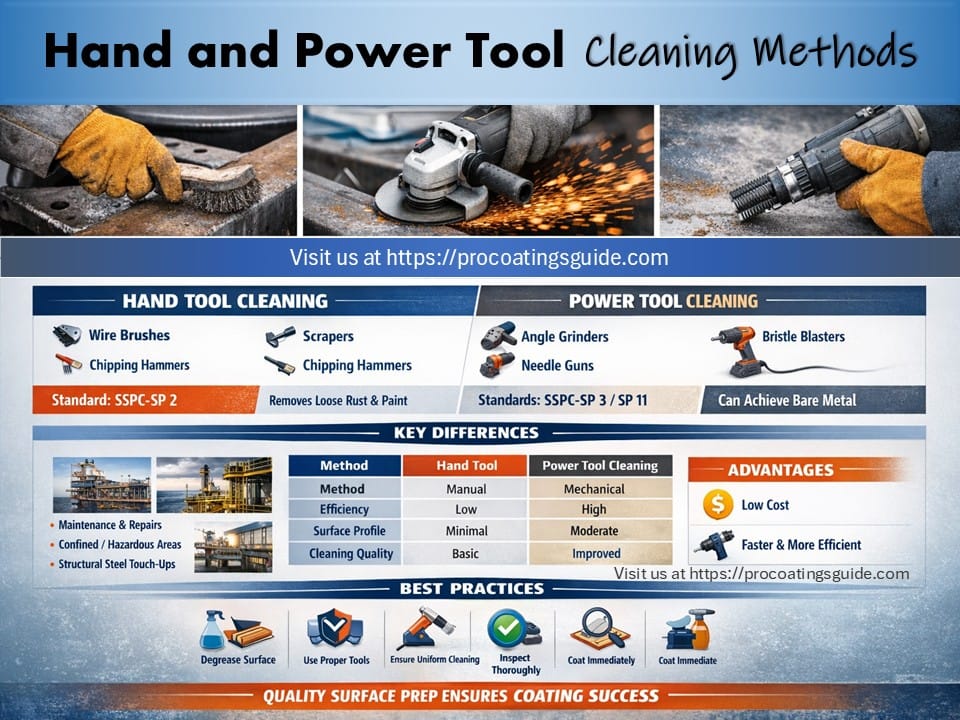
The surface preparation process focuses on attaining a clean surface to which a coating system will successfully bond. The core components of this process are the removal of detrimental foreign material from the surface of the steel and the creation of a surface profile. Both hand and power tool cleaning can be used to remove this material which includes rust, mill scale, and existing coatings.
The type of tool used will influence the appearance and level of cleanliness of the substrate. Some tools may remove contamination and create a profile in a similar manner to abrasive blasting. Other tools may have less of an effect. As an example, a wire brush will only remove loosely adhered material from a surface, whereas a grinder can remove loose material, tight material, and weld splatter. It is about using the right tool for the job.
As their names indicate:
- Hand tool cleaning is a method to prepare steel surfaces using non-powered hand tools.
- Power tool cleaning is a method to prepare steel surfaces using power-assisted hand tools
Hand Tool Cleaning
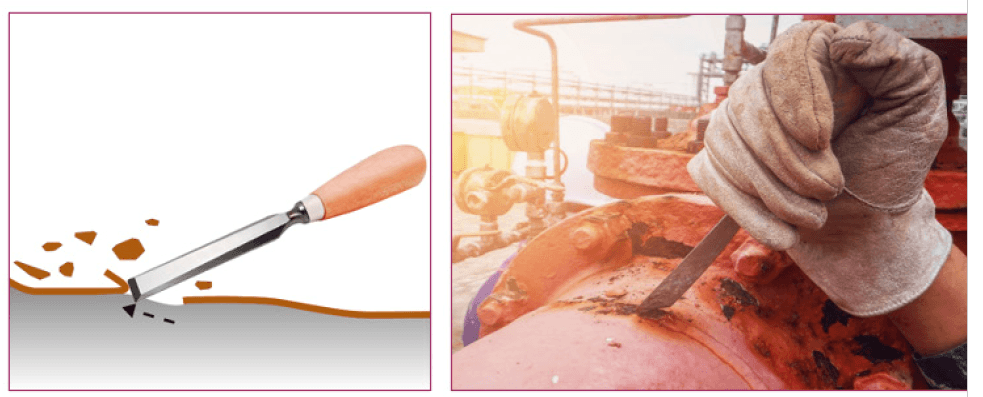
Hand tool cleaning involves manually chipping, scraping, brushing, and sanding the surface to remove foreign material. Hand tool cleaning can typically remove all loose mill scale, coatings, rust, and other loose detrimental materials. Adherent materials cannot generally be removed by this process in a high production environment.
There are several situations when hand tools are used for surface preparation, such as when:
- Power tools are not available or not allowed for the job.
- The surface is in a hard-to-reach spot or complex configuration that power tools cannot access.
- It is a small surface area that doesn’t require power tools.
Limitations:
- Hand tools alone cannot be used for most high-performance coating systems or systems that require a truly clean substrate.
- In these situations, hand tools are used in conjunction with power tool cleaning in order to achieve the desired level of cleanliness specified by the standard.
Hand Tools
- There are many different types of hand tools that can be used to prepare surfaces.
- The type of tool selected is dependent on the location and condition of the surface, in addition to any requirements outlined in the specification.
- It is important that the right tool is chosen for the job; otherwise, the surface could become damaged, causing more harm than good.
- These tools are only intended to remove loosely adhering corrosion products, old paint, and flaking mill scale and are not intended to produce a surface profile on the steel.
- Hand tools are frequently used to prepare surfaces for spot touch-ups during maintenance painting activities.
Chipping Hammers
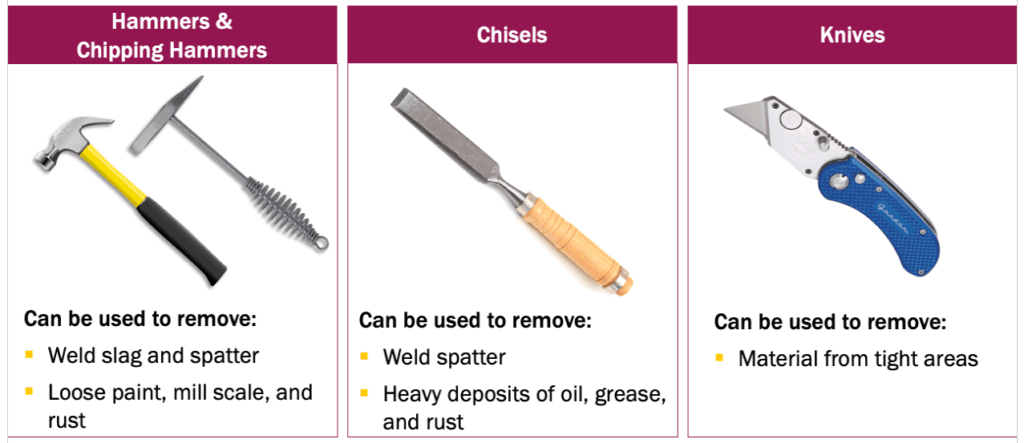
- Chipping hammers are mainly used for removing weld slag and splatter. They can also be used to remove loose paint, loose mill scale, and loose rust from the surface.
- Chipping hammers are a good tool to start with to remove material from tight areas and welds. It is also a good tool to use for fine-tuning after all the loose material has been removed.
- It is important to note that great care must be taken when using a chipping hammer as it can leave great impressions in the steel that can be seen after the coating is applied and cured.
Chisels and Knives
- A chisel can be used to get under the loose paint, mill scale, and rust to remove all loose adherent materials.
- Care should also be taken when using chisels as they too can dig into the metal surface, leaving gouges that are visible after the coating has been applied.
- When working in small areas, a knife may be used to get into tight workspaces that other tools cannot.
Scrapers
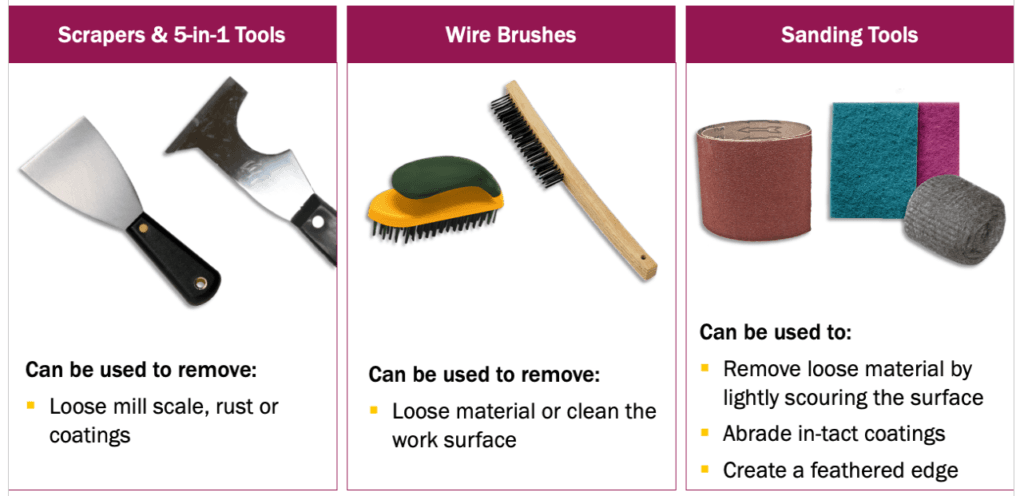
- A scraper is a hand tool used to remove loosely adhered coating, rust and mill scale.
- There are many variations of this tool, including the 5-in-1 tool that can perform multiple tasks from opening paint to cleaning rollers to scraping loose coating or mill scale.
Wire Brushes
- Wire brushes are available in many varieties and are used to lightly scour the surface. They are also useful in abrading an existing coating or for removing moderate amounts of rust.
- In addition, brushes are used for clearing the work surface of dirt, dust, loose coating, loose rust, and mill scale after scraping has been performed.
- In addition, wire brushes are useful hand tools that are used for clearing the work surface of dirt, dust, loose coating, loose rust, and mill scale after scraping has been performed.
- Just like wire brushes, sandpaper, steel wool, and non-woven pads are used to lightly scour the surface, abrading the existing coating.
Sanding Tools
- Sanding tools include sandpaper, steel wool, and non-woven pads.
- These tools can be used to get under the loose paint, mill scale, and rust to remove all loose adherent materials.
- They can also be used to achieve a feathered edge.
Power Tool Cleaning
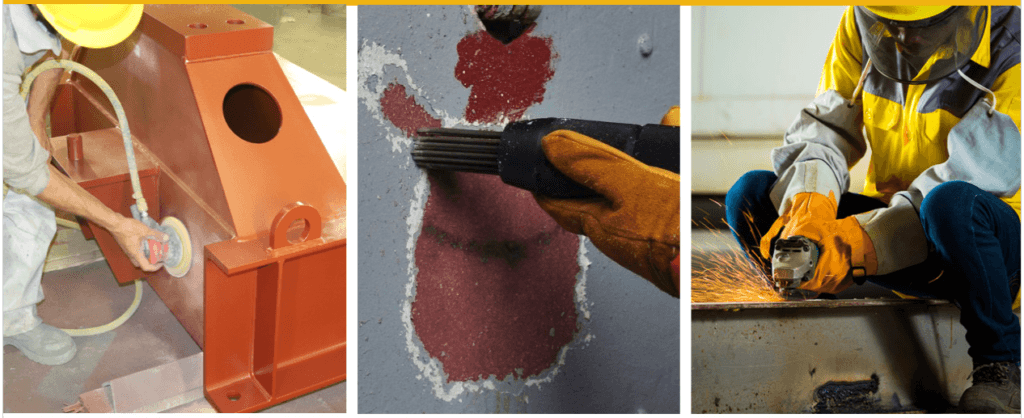
Power tool cleaning, on the other hand, can typically remove loosely and tightly adherent mill scale, rust, paint, and other foreign matter, depending on the tool used. This is due to power tools utilizing mechanical force to impact, grind, sand, cut, scale, and brush the surface. Power tools clean by impact and/or abrasion and are used frequently for small repairs or spot cleaning of damaged coatings. Other advantages of power tools include:
- Can be performed in tight spaces.
- Can be used around sensitive equipment when abrasive blasting is not an option and in confined spaces, if the tools are intrinsically safe.
- Suitable for small areas when blasting would be inefficient or for spot repairs of damaged coatings.
- To prepare the surface prior to abrasive blasting
– Cleaning challenging areas (e.g., gaps, bolts, threads)
– Rectifying surface defects (e.g., laminations, inclusions)
– Rectifying fabrication defects (e.g., sharp edges, weld spatter). - Can create a surface (anchor) profile depending on the tool – however, the surface profile is rarely as uniform as the profile that can be achieved with abrasive blasting.
Limitations:
- Power Tool cleaning requires a power source, such as electricity or compressed air, which depending on the job site, may not readily available.
- In addition, the power tool media wears out quickly and must be replaced frequently during the cleaning process if the surface area to be cleaned is very large.
- Also, some power tool cleaning methods cannot remove tightly adhered mill scale, paint, or rust.
- And finally, different tools leave very different textures on the surface.
Power Tools
- Like hand tool cleaning, it is important that the right tool is chosen for the job.
- The selection of power tools is dependent on many factors, including the amount of surface area to be cleaned, the configuration of the surface, and the level of control required for worker and environmental protection.
- Selection is also dependent on whether surface roughness is a direct requirement of the referenced SSPC surface cleanliness standards or if a surface profile is required by the specification.
- There is a range of power tools that can be used to prepare surfaces. These tools can be grouped into two categories, impact cleaning tools and, rotary or grinding cleaning tools.
1. Impact Cleaning Tools
- Impact cleaning tools typically use an internal piston to drive a hardened edge repeatedly against the target surface or vibrate against the surface, to knock loose foreign materials.
- An advantage of impact tools is that they are typically capable of producing a surface profile of 25 µm (1.0 mil) and greater on mild steel.
- A disadvantage is that some impact tools present the possibility of gouging the metal and leaving sharp burrs, especially if excessive pressure or an overly long dwell time is used. These burrs and gouges may then require smoothing prior to coating application, and this limits the efficiency of preparing surfaces with this class of tools.
- It is also important to note, that impact tools must also be kept sharp, or they can drive rust and mil scale further into the surface profile.
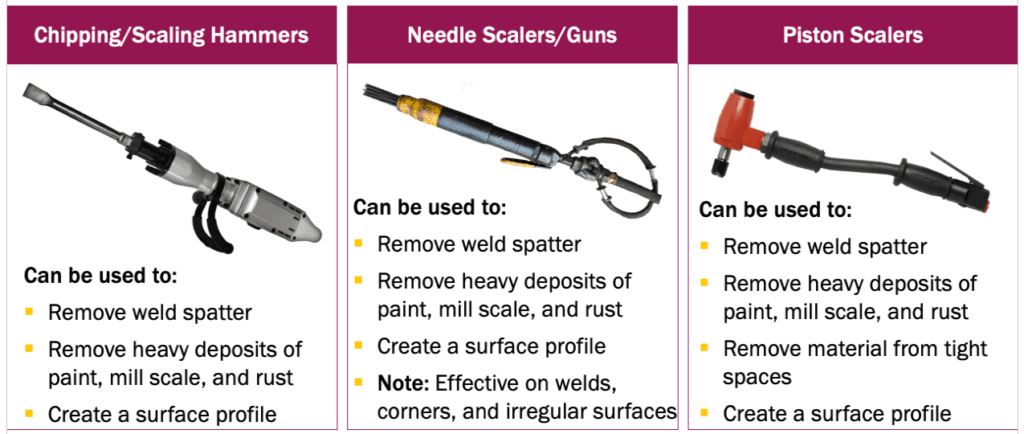
Chipping/Scaling Hammers
- Chipping or scaling hammers are the most widely used impact tool and consist of air or electrically operated pistons that transmit impact to the surface using a chisel.
- Scaling hammers are used for scrapping and chipping away at thick deposits of rust, mill scale, weld slag as well as thick layers of paint.
- The use of this tool is generally a slow, costly method to clean surfaces, but when considerable rust scale or heavy paint formation is present, they prove to be economical.
Needle Scalers
- Needle scalers or needle guns consist of several hardened steel rods that vibrate sharply against the surface, breaking up any mill scale, rust, or paint on the surface.
- Needle scaling is slow work as it burnishes while surface producing a surface profile. Needle scalers are effective on welds, corners, and irregular surfaces. However, the needles can dull fast and may need to be replaced often.
Piston Scalers
- Piston scalers operate similarly to scaling hammers, but the piston itself acts as the impact tool.
- A hammer piston takes the place of the chisel. It is a circular shaft with the cutting end cross shaped, somewhat like a star chisel.
- These scalers are available with one, two, or three pistons operating in one tool. Large assemblies with as many as 15 pistons are also available for use on flat, horizontal surfaces such as steel decks.
- Like scaling hammers, piston scales also create a surface profile.
2. Rotary or Grinding Tools
- Rotary or grinding tools clean by brushing, grinding and sanding the surface.
- They consist of an abrasive material, such as discs, peen flaps, wire brushes, or grinding wheels that spin at high speeds cutting into the surface.
- Rotary and grinding tools complete most jobs quicker than hand tools. It should be noted that some specialty power tools can be used to impart a surface profile of 1.0 mil or greater.
- It is important to note that overworking with these tools may result in a “polished” surface that provides poor adhesion for coatings. In extreme cases, burnishing of the surface or partial melting of the surface may occur.
- Rotary tools can also spread existing oil and grease across the surface, which must then be removed prior to coating application.
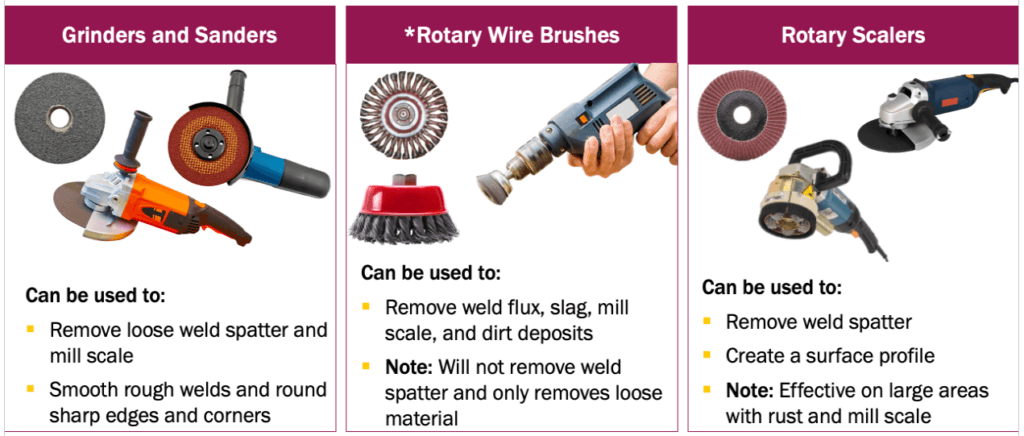
Grinders and Sanders
- Grinders and sanders are the most widely used rotary tool and are frequently used to repair minor fabrication defects. Grinding is appropriate to remove weld spatter, smooth weld seams, or round off sharp edges or corners.
- Cleaning large areas with these tools is very expensive. Sanders and grinders remove contamination by shearing the surface. The shearing action means that the process will have little effect on surface depressions, leaving the surface to appear to be potentially clean but still have contamination in pits.
- The machines powering these tools may be the same as those used for power wire brushing, with suitable sanding discs or grinding wheels substituted for the wire brushes.
- The abrasive grit size used with these tools is critical. A rougher grit disc creates a deeper surface profile on the substrate. Consequently, a finer grit creates less of a surface profile.
Rotary Wire Brushes
- Rotary wire brushes can be used to remove loose paint, light mill scale, rust, weld flux, slag, and dirt deposits.
- The heads come in a variety of sizes, and selecting the appropriate wire type, and hardness are important factors.
- Overworking the surface with a wire brush can be detrimental because excessive burnishing develops a polished surface, which is a poor anchor for most coatings.
- Rotary power wire brushes can also easily spread oil and grease over the surface and polish the surface rather than remove contaminants. Therefore, solvent cleaning is an essential step before power wire brushing.
Rotary Scalers
- Rotary scalers can be used effectively on large areas to remove rust and scale.
- They require careful use to avoid cutting the metal to such an extent that metallic points extend far above the surface, which causes early coating failure due to insufficient coverage.
- Rotary scalers produce a very rough surface; therefore, you must ensure that all peaks of the anchor pattern are covered by the coating.
Specialty Tools
- There are some newer power tools on the market that have fine-tuned the mechanical preparation process and can produce a surface like those that have been abrasive blasted.
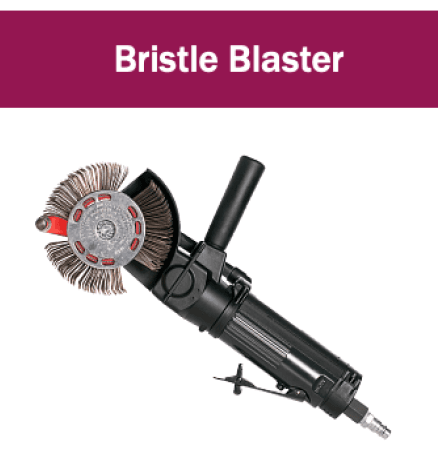
- One of these tools is the Bristle Blaster. Although the Bristle Blaster provides an angular profile, similar to abrasive blasting, it is still a power tool that can best provide surface preparation in accordance with SSPC-SP 11 and SSPC-SP 15.
- Other companies such as 3M Scotch Bright and Desco Manufacturing also make a line of pneumatic and electrically powered tools and or industrial abrasive heads or attachments that can be used for cleaning and metal deburring.
- Some of these tools may clean in accordance with SSPC-SP 11. The surface profile varies by selection of the sanding disc or tool used. Some specialty tools may be equipped with a vacuum shroud to control dust.
Hand and Power Tool Cleaning Standards
- Both hand tool cleaning and power tool cleaning are governed by industry standards. Standards are formal documents produced by key industry bodies that provide guidance for carrying out technical procedures.
- Standards are important as they establish a reasonable expectation of the quality of the finished product.
- Surface preparation standards achieve this by enabling the user to identify the initial condition of the surface and to determine if the required cleanliness level has been achieved.
- There are two key organizations that have developed hand and power tool cleaning standards. They are the Society for Protective Coatings (SSPC) and the International Standards Organization (ISO). It should be noted that SSPC has separate standards for hand tool cleaning and power tool cleaning, whereas ISO combines hand and power tool cleaning into one standard with two grades of cleanliness.
- The most cited standards for preparing metal substrates with hand and power tools are:
- SSPC-SP 2 – Hand Tool Cleaning
- SSPC-SP 3 – Power Tool Cleaning
- SSPC-SP 11 – Power Tool Cleaning to Bare Metal
- SSPC-SP 15 – Commercial Grade Power Tool Cleaning
- SSPC-VIS 3 – Guide & Reference Photographs for Steel Surface Prepared by Power and Hand Tool Cleaning
- ISO 8501-1 St 2 – Thorough Hand and Power Tool Cleaning
- ISO 8501-1 St 3 – Very Thorough Hand and Power Tool Cleaning
▶️ Detailed Article on Hand and Power Tool Cleaning Standards…Click Here
Hand and Power Tool Safety Precautions:
- Both hand and power tool cleaning can cause bodily harm if not used correctly.
- Wear proper PPE (helmet, gloves, goggles, mask, safety shoes)
- Check tools for damage before use
- Use the right tool for the job
- Keep a firm grip and proper posture
- Do not use damaged or loose tools
- Ensure power tools are properly connected and grounded
- Never remove safety guards
- Switch off tools before changing accessories
- Control dust and debris (use mask/ventilation)
- Take regular breaks to avoid fatigue
- Use proper support when working at height
- Keep fire extinguisher nearby
- Clean area after work and store tools safely
- Report any unsafe condition immediately